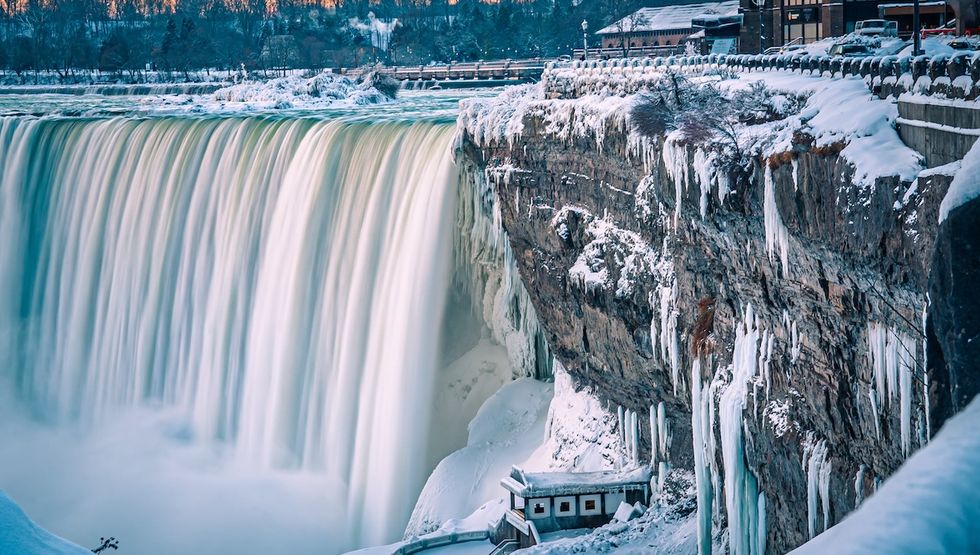
Niagara Falls has turned into an icy wonderland during Ontario's deep freeze

Niagara Falls is frozen! Well, technically, it may look like it is, but the massive rushing spectacle is not even close to being an icicle. With Ontario reaching near-freezing temperatures this time of year, you may be left to wonder how Niagara Falls is still flowing in the winter. I’ve got the answer for you.
Though the falls appear frozen to the naked eye, it’s actually the mist and spray that have formed a crust of ice over top of the rushing water.
This in turn creates the illusion that the falls have stopped. You’ll find that the water continues to freely flow underneath the sheets of ice.
“While the Falls never truly freeze, it does turn into an icy wonderland with all of the mist and steam freezing on the rock and railings around the Falls,” Niagara Falls Tourism shares with Curiocity. “There is just too much water for the falls to stop flowing.”
Which makes sense. In all honesty, the thought of Niagara Falls being fully frozen over feels almost apocalyptic.
View this post on Instagram
Low flow in the winter
Though the mist and steam do its magic, in the winter, about 75% of water flowing from Lake Erie to the Niagara River is diverted before it hits the Falls. This occurs through tunnels and canals for hydro-electric reasons. The water then returns into the lower Niagara River, which Niagara Parks shares.
According to the Niagara Parks site, about 85 million litres of water falls over Horseshoe Falls every minute in comparison to 170 million litres from April 1 to October 31.
So if you really think about it, having less water also contributes to the chance of seeing a “frozen” appearance.
And after reading this if you think that Niagara Falls has never frozen over or will, you’re also wrong – sorry!
Have the Niagara Falls ever stopped flowing?
It actually did freeze over once, although it wasn’t in our lifetime. The Niagara Falls “ceased its flow,” for 30 hours in March of 1848.
“High winds set the ice fields of Lake Erie in motion and millions of tons of ice became lodged at the source of the river, blocking the channel completely,” shares Niagara Parks.
View this post on Instagram
“Local inhabitants, accustomed to the sound of the river, heard an eerie silence and those who were brave enough, walked or rode horses over the exposed basin.”
A self-made dam was made! It held the water back until a shift allowed the built-up weight of water to break through. And thanks to the annual installation of the ice boom, it has stopped this from happening ever since then. Good thing!
But still, the illusion of a frozen Niagara Falls is a beautiful reminder of nature’s power and its ability to put on a spectacular winter show. And if you’re set on seeing a fully frozen waterfall, Ontario has just the spot. During the coldest months, Kakabeka Falls, Ontario’s second-largest cascade, typically freezes over.
So, the next time someone tells you Niagara Falls has frozen over, you’ll know the truth, and you’ll even have another option to offer.
Recent Posts:
Canada’s top employers for young people include these companies & they’re hiring
This Ontario city is transforming a central square to a ski hill
Karen Doradea
Managing Editor, Toronto – Karen is a multimedia journalist based in Toronto. With a strong knowledge of reporting and editing through all forms of media, she has a true passion for storytelling. She carries several years of journalistic experience and has covered the Toronto scene from local stories to national news. When Karen isn’t publishing fire content, you can find her binge-watching sitcoms on Crave, at a must-try restaurant, or scrolling endlessly on TikTok looking for the next best thing – News never sleeps.
Read articles