There are a total of six UNESCO World Heritage Sites in Alberta, and we’re here to tell you all about them.
The United Nations Educational, Scientific and Cultural Organization (UNESCO) works with countries around the world to identify World Heritage sites. As of now, there are over 1,000 sites that have made the list. Out of the 22 in Canada, six are in the province we call home.
We’re going to give you the rundown on each of these sites, as well as the dates that they officially became identified as World Heritage sites. Above all, though, they’re all great sites in the end. Let’s get into the details, folks.
Dinosaur Provincial Park
View this post on Instagram
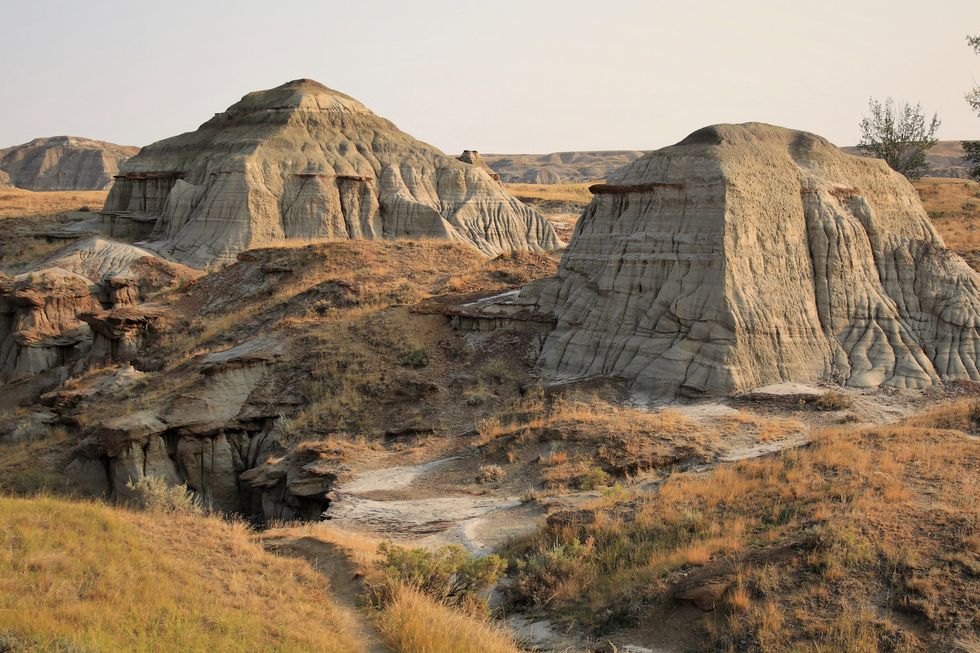
According to UNESCO, this park is “unmatched” in terms of the number and variety of brilliant specimens found. The even crazier part? Some of these specimens date back a whopping 75 to 77 million years. It’s been recognized as a site for the longest time, as well, with it being the first one inscribed in 1979.
“The property is outstanding in the number and variety of high-quality specimens representing every known group of Cretaceous dinosaurs. The diversity affords excellent opportunities for paleontology that is both comparative and chronological,” they explain.
Where: Directions
Head-Smashed-In Buffalo Jump
This museum of Blackfoot culture is over 6,000 years old. Since 1981, it has been a UNESCO-designated World Heritage Site to preserve its history.
If you aren’t familiar, the Blackfoot were fierce and successful warriors. They controlled a vast region stretching from the North Saskatchewan River in Alberta to the Yellowstone River of Montana. This also includes the Rocky Mountains to the Cypress Hills on the Alberta-Saskatchewan border.
At this location, Blackfoot people would use a buffalo jump. It’s a certain cliff formation used to kill bison by running them off a cliff and finishing them off at the bottom. This technique was used for over 4,000 years; incredible, right?
Where: Secondary Highway #785, 275068 AB-785, Fort MacLeod, Alta.
Wood Buffalo National Park
Spanning the Alberta-Northwest Territories border, this is actually the largest national park in Canada. Not only that, but according to UNESCO, Wood Buffalo National Park is also home to North America’s largest population of wild bison. It was designated as a World Heritage site in 1983, and it continues to be home to the world’s largest herd of wood bison, a threatened species.
UNESCO describes it as “an outstanding example of ongoing ecological and biological processes encompassing some of the largest undisturbed grass and sedge meadows left in North America.”
Where: Directions
Canadian Rocky Mountain Parks
This was the fourth spot in Alberta (and beyond) to be named a World Heritage site, officially getting its title in 1984.
It consists of the national parks Banff, Jasper, Kootenay and Yoho. There’s more, however, as it also includes the Mount Robson, Mount Assiniboine and Hamber provincial parks. In fact, this site is renowned for its striking mountain landscape and outstanding physical features in all aspects.
Where: Directions
Waterton Glacier International Peace Park
View this post on Instagram
According to UNESCO, in 1932, Waterton Lakes National Park, in Canada, was combined with Glacier National Park, in the United States, to form the world’s first International Peace Park.
In essence, the park offers significant scenic values. Not only that, but it’s also home to an abundant and diverse selection of flora and fauna. In 1995, it was officially named a site and continues to be a unique, distinct landscape in the area.
Where: Waterton Park, Alta.
Áísínai’pi or Writing-on-Stone Provincial Park
“Writing-on-Stone/Áísínai’pi is a sacred site in a mixed grassland prairie region on the northern edge of the Great Plains,” according to Parks Canada.
“The Blackfoot people Nation (Siksikáítsitapi) has left engravings and paintings on the sandstone walls of the Milk River Valley, which bear witness to spirit messages. The landscape is considered to be sacred by the Blackfoot people, and centuries-old traditions are perpetuated today in various ceremonies and in the respect in which the place is held.”
Today, this rural community is sustained by ranching and farming. Featuring carvings that date back over 3,000 years, this particular park continues to be a popular place. Whether it’s for traditional ceremonies, vision quests, or prayer, it’s definitely worth a walk-through. Subsequently, it was named a World Heritage Site in 2019.
Where: NW 36 TW1 Range 13, Milk River, Alta.
Recent posts:
The world’s largest duck-themed bounce house is making its Calgary debut this summer
Winnie the Pooh and friends are being featured at Edmonton’s Muttart Conservatory

Alyssa Gallardo
Alyssa is a Staff Writer for Dished and Curiocity Edmonton. She’s a big fan of everything entertainment, and can always be seen running around the city going from concert to concert.
Read articles