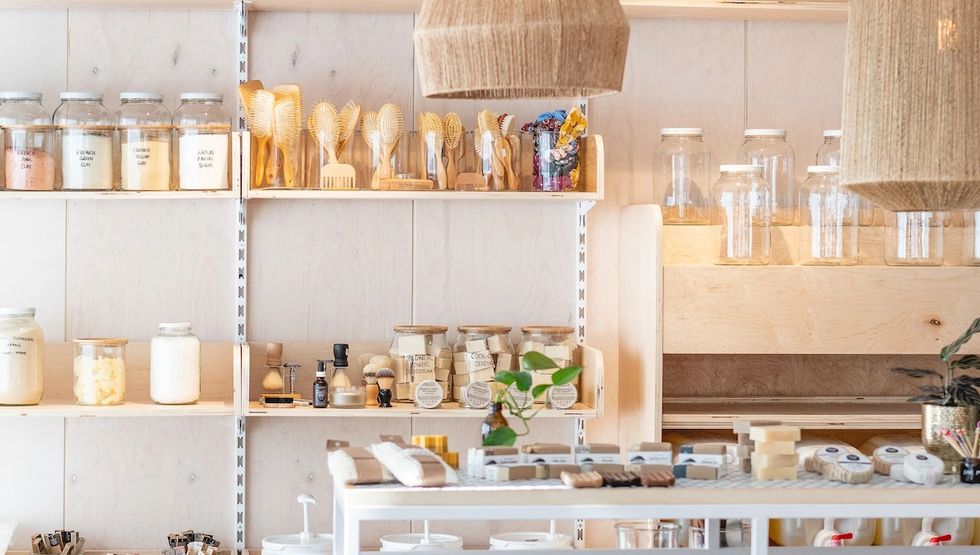
There’s a Toronto-based retailer known for selling package-free, refillable home and body goods through reusable containers. As one of the city’s few names focused on sustainability, bare market offers a practical approach to reducing waste.
Eastenders may be familiar with the name. The physical store was located at 1480 Danforth Avenue, but on May 19, 2024, they officially closed their doors. Though the decision was a difficult one, bare market transitioned online and even partnered with five small businesses in the east end. They launched a Bring Your Own Containers program at Ethical Local Market, One Last Thing, Mischief Makers, Magpie Cakery Baking Studio and Canopy Kids to continue offering refills while also helping bring in foot traffic to these stores.
BYOC to ‘zero-waste’
How it works is pretty simple; Drop off your own container at a partner shop for their bulk items, fill out a form with your contact information, it then gets picked up on a Wednesday or Saturday and once it’s ready, you pay. It then gets delivered at the partner store or right to your home. And you can continue to do this process by refilling the same containers.
Just make sure the one you bring is clean, dry and clear, with a lid. Plastic or glass, just make sure there are no chips or cracks! All the containers you bring should also be placed in a bag or box to you get the right order.
This convenient system not only simplifies refilling essentials but also helps sustain the low-waste movement at a time when local businesses have struggled to stay open.
“We’ve watched many refill stores and even neighbourhood shops close in the past few years. That’s why we adapted our model – to continue making low-waste and local goods accessible to busy people who want sustainable goods delivered to their door,” shared Dayna Stein, founder of bare market, with Curiocity.
View this post on Instagram
Canada made & locally sourced
They call themselves ‘Canada’s Online Shop for Low Waste Goods + Refills’ because not only do they offer their services locally but Canada-wide too, through delivery. Though the BYOC method only works in Toronto, for those purchasing from bare market in other parts of Canada, liquids are packed in deposit pouches and jars, while powders are packed in paper bags. Shipping in Ontario is $15 while the rest of Canada is $22.
Beyond their packaging and delivery options, many of the products available also come from small-scale Canadian producers and manufacturers. Some of the many Canadian brands they carry include:
- Carina Organics
- Nellie’s
- Pure Nature
- Pure
- Oneka Elements
- The Soap Works
- Old Soul Soap Company
- La Petite Ourse
- Anointment
About 71% of their brands are Canadian while about 14.7% are from the US., and 13.6% from international names.
“Additionally, all of our makeup, cleansers, toners, face creams, serums, eye gels, massage oil, apricot scrub, and bubble baths are manufactured in Canada by Canadian companies,” mentions Stein.
As for their bestsellers, their bulk products continue to lead in that department. These are all Canadian-made but as for their DIY ingredients, they are sourced based on where they naturally grow, according to Stein.
Some of their current customer favourites are:
- Lemon mint dish and hand soap
- Lavender eucalyptus laundry detergent
- Dishwasher tabs and dishwasher powder
- Sodium percarbonate
- Conventional olive oil
- Organic masala chai
“We’re working on updating our website in the coming days to clearly indicate the country of origin for each product, so customers can make more informed decisions,” she added.
View this post on Instagram
Living for the future
While the team works on making product origins more transparent, Stein also emphasizes that sustainability isn’t about perfection but rather taking small, achievable steps. For someone who is interested in adapting to a more ‘low waste’ lifestyle, Stein shares a few tips as to how to get started.
“I’d actually suggest reframing the idea from ‘zero waste’, which is nearly impossible at an individual level, to ‘low waste’ or ‘waste reduction’. Small, manageable changes add up quickly,” she states.
She recommends starting with one area of your home, like the kitchen or bathroom. “For example, refill one product instead of buying a new packaged version, use up what you have before replacing with a more sustainable alternative (i.e. don’t recycle your perfectly good plastic hairbrush for a wooden alternative if it still has life to live), and swap single-use items for durable, reusable ones when it makes sense for you.”
Save the planet, save some money
Not only is it good for the planet, it makes a difference in your wallet too!
Stein agrees that you can also save money by buying sustainably, especially at bare market.
“Our Carina Organics products are a slightly more premium product compared to big box store brands. But compared to the same brand pre-packed in a regular store, our Carina Organics prices can be up to 48% cheaper for the same quantity. i.e. 360ml of Carina Organics shampoo has a $14.99 SRP in normal retail stores, but the same volume would cost $10.80 with bare market (maybe less because we actually charge in g not ml), at our 1L online pricing,” she shares. “That’s 28% cheaper!”
Cost savings are one incentive, but the bigger impact comes from the shift toward reducing waste. Small changes can have a significant impact over time – especially if more people are taking part.
“In 2023 alone, we helped divert 106,000 single-use containers from landfill through refills at our shop,” said Stein. “That’s a huge impact – but to put it into perspective, in just our first 6 weeks before COVID hit, we had already diverted 26,000 units.”
View this post on Instagram
The community comes first
These numbers highlight how supporting stores like bare market can add up to meaningful change, both on an individual and community level.
And the community is truly where its heart lies. Partnerships have been a huge part of bare market, whether that be through its hosted workshops on sustainability and low-waste living, providing refills for local organizations or even setting up a Personal Care Bank outside the shop.
That deep connection with the community became even more evident when the shop closed. “One of the most meaningful things we experienced when closing our storefront was hearing from customers, often in tears, about how much our shop changed the way they consume at home,” added Stein.
“That’s why we’re still here – adapting to economic shifts like these tariffs and inflation while keeping sustainability accessible.”
Even without a storefront, bare market’s impact proves that sustainability isn’t just a thing, it’s a movement.
It’s a movement that I try to embrace in my day to day – though it’s not always perfect. I’ll be honest, some days I forget my reusable bags or struggle to find low-waste alternatives. But knowing that businesses like bare market exist, evolving and making sustainability more accessible, reminds me that every small effort counts. As Stein put it, “small, manageable changes add up quickly.”
And maybe that’s the real takeaway here – progress, not perfection. We’ll get to the latter, some day.
Recent Posts:
Ontario park known for its ‘frozen’ waterfall has a new ice skating loop
Parks Canada is hiring for thousands of student summer jobs right now

Karen Doradea
Managing Editor, Toronto – Karen is a multimedia journalist based in Toronto. With a strong knowledge of reporting and editing through all forms of media, she has a true passion for storytelling. She carries several years of journalistic experience and has covered the Toronto scene from local stories to national news. When Karen isn’t publishing fire content, you can find her binge-watching sitcoms on Crave, at a must-try restaurant, or scrolling endlessly on TikTok looking for the next best thing – News never sleeps.
Read articles